By Miles J. Edwards | Grab Tha Bootleg (GTB) | November 22, 2026
Sometimes the most dangerous thing in the woods isn’t the person holding the gun. It’s the screenplay that put everybody there in the first place.
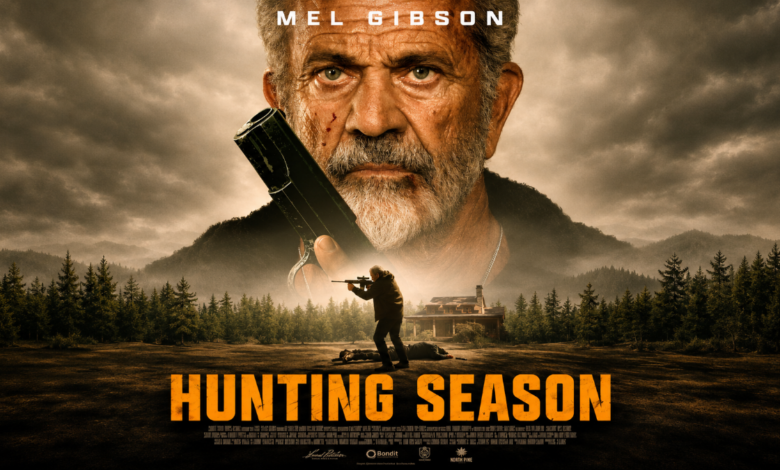
Mel Gibson returns to familiar territory in Hunting Season, a 2025 action thriller featuring an aging tough guy, a secluded home, a dangerous criminal organization, and enough firepower to remind audiences that some Hollywood stars never quite retire from shooting people on screen. Unfortunately, while Gibson still has the presence to carry an action movie, the material surrounding him doesn’t always give him much worth carrying.
Directed by R.J. Collins and written by Adam Hampton, Hunting Season was released by Samuel Goldwyn Films on December 5, 2025, receiving a limited theatrical release in the United States while simultaneously becoming available for digital purchase and video-on-demand rentals. Unlike major studio productions that typically receive an exclusive theatrical window before arriving on home entertainment platforms, Hunting Season allowed audiences to watch the movie at home on its opening day.
The film follows Bowdrie (Gibson), a reclusive father living with his daughter, Tag (Sofia Hublitz), in a remote wooded community. Their relatively peaceful existence is interrupted when they discover January (Shelley Hennig), an injured young woman whose troubles are considerably more dangerous than they initially realize. Before long, a ruthless drug lord named Alejandro (Jordi Mollà) and his associates come looking for her, turning an act of compassion into a fight for survival.
On paper, the premise sounds like a dependable recipe for an entertaining action thriller. A hardened father, a daughter trained to survive, and criminals who have wandered into the wrong territory should make for an exciting confrontation. Unfortunately, Hunting Season doesn’t always make the most of its promising setup, leaving Gibson to carry a film that could have benefited from tighter storytelling and more compelling character development.
Same Old Gibson, Different Woods
There was a time when putting Mel Gibson in an action movie was practically a guarantee that somebody was going to have a very bad day. From Lethal Weapon to Payback, Gibson built a career playing men who could deliver a wisecrack, take a beating, and return the favor with interest. Decades later, the formula remains recognizable, even if the productions surrounding him have become considerably smaller. Gibson may no longer be the youthful action star audiences remember, but he still knows how to portray a man who shouldn’t be underestimated.
In Hunting Season, Gibson’s weathered appearance works in the character’s favor. Bowdrie isn’t supposed to be a polished action hero who spends his mornings at the gym and his afternoons saving civilization. He’s a rugged, withdrawn father whose primary concern is keeping his daughter safe. The role plays to Gibson’s established screen persona, allowing his age and rough edges to become characteristics rather than obstacles. His performance gives Bowdrie a believable toughness that fits naturally into the film’s isolated, unforgiving environment.
The problem is that a convincing tough guy doesn’t automatically make a compelling movie. Bowdrie’s mysterious background offers the possibility of a more interesting character study, but the screenplay seems more interested in establishing what he can do to dangerous people than exploring who he actually is. There’s enough material here to develop a compelling character with a complicated past, yet the film largely settles for the familiar image of a hardened man who would rather be left alone until trouble comes knocking.
A Father-Daughter Story That Could Have Been More
One of the film’s more promising elements is the relationship between Bowdrie and Tag. Rather than portraying his daughter as a helpless child waiting for rescue, the story establishes that Bowdrie has raised her to be independent and capable of defending herself. It’s an interesting foundation for a survival thriller because it creates opportunities for both characters to contribute to their predicament instead of relying entirely on the father to solve everything. Their unusual lifestyle also suggests a relationship shaped by isolation, discipline, and a shared understanding that danger can arrive without warning.
Hublitz, recognizable from Netflix’s Ozark, brings another potentially interesting dimension to the production. Her character has grown up under circumstances far removed from ordinary teenage life, and that upbringing could have provided a stronger emotional conflict between independence, protection, and the consequences of isolation. Unfortunately, the film doesn’t fully capitalize on the relationship’s dramatic potential, leaving much of its emotional weight dependent on the audience’s willingness to accept the familiar protective-father storyline.
January’s arrival introduces an additional moral dilemma that could have given the story greater emotional depth. Helping an injured stranger may be the right thing to do, but what happens when that decision places your own family in danger? Bowdrie must confront the consequences of extending compassion to someone whose past threatens to destroy the life he has built for his daughter. It’s the kind of conflict that could elevate a conventional action story into something more substantial, but the film doesn’t explore those themes deeply enough to distinguish itself from countless other survival thrillers.
The First Hour: Are We Hunting or Waiting?
If you’re expecting Hunting Season to deliver nonstop action from the opening scene, you might want to bring a little patience. Actually, bring a lot of patience, because this movie takes its sweet time getting started. Much of the opening hour is devoted to establishing the characters, introducing their circumstances, and gradually revealing the danger approaching Bowdrie’s secluded world. While some of that development is necessary, the pacing feels sluggish for a film marketed as an action thriller starring Mel Gibson.
In fact, the movie doesn’t really begin delivering the action audiences are waiting for until exactly the one-hour mark. That’s when Hunting Season finally begins living up to its title, shifting from a slow-moving drama into the kind of confrontation viewers probably expected much earlier. The change in momentum is noticeable, and the film becomes more engaging once Bowdrie is forced to deal directly with the threats surrounding his family. The question, however, is whether the preceding hour offers enough substance to justify the wait.
A slow-building thriller can be incredibly effective when its early scenes create suspense, develop meaningful relationships, or introduce complications that make the eventual confrontation more rewarding. Unfortunately, Hunting Season struggles to generate that level of anticipation because its storyline follows such a recognizable formula. Audiences familiar with Gibson’s action films already have a reasonable idea of how events will unfold, and the movie rarely provides enough surprises to challenge those expectations. There’s a difference between building suspense and testing an audience’s patience, and this film spends a little too much time doing the latter.
Once the action arrives, Gibson returns to more familiar territory, and the film finally develops the energy its premise promises. The confrontations provide a welcome change from the earlier dialogue-heavy scenes, but the uneven distribution of action and character development prevents the movie from maintaining consistent momentum. Rather than allowing tension to build naturally throughout the story, Hunting Season feels like two different films competing for the audience’s attention: a restrained family drama followed by a conventional action thriller.
When the Villain Becomes the Problem
Every action thriller needs an antagonist worth fearing, and Jordi Mollà’s Alejandro is positioned to fill that role. A violent criminal pursuing an injured woman into an isolated community should provide plenty of tension, particularly when he encounters a father who isn’t easily intimidated. However, an effective villain needs more than a willingness to threaten people. His presence must convince the audience that the protagonists are facing a genuinely dangerous adversary capable of challenging them both physically and psychologically.
Alejandro certainly possesses the ruthless intentions expected of a criminal antagonist, but the character occasionally feels more like a collection of familiar movie-villain characteristics than a genuinely intimidating individual. His exaggerated behavior and dialogue sometimes undermine the menace the film is trying to establish, making it difficult to take every confrontation as seriously as the filmmakers apparently intended. Rather than developing an unpredictable adversary whose decisions create genuine uncertainty, the screenplay relies heavily on familiar criminal behavior and threats.
That predictability weakens the central conflict because audiences accustomed to Gibson’s action films can anticipate the general direction of the confrontation. There is nothing inherently wrong with a traditional battle between a reluctant protector and a ruthless criminal, but the most memorable examples of the genre find creative ways to challenge expectations. Hunting Season rarely ventures far enough beyond its familiar setup to make Alejandro particularly memorable, leaving Gibson’s character as the primary reason to remain invested in the outcome.
Is There Enough Action to Make It Worthwhile?
When Hunting Season finally shifts into action mode, there are glimpses of the entertaining thriller it could have been. Gibson’s commanding screen presence remains one of the film’s strongest assets, and the confrontations allow him to demonstrate the intimidating confidence that helped establish his reputation as an action star. The remote environment also provides a suitable backdrop for violence and survival, giving the movie a rugged atmosphere that complements its leading character. The isolation adds a sense of vulnerability, particularly when the family’s home becomes the setting for a conflict they never invited.
The action itself is serviceable, but the film doesn’t offer enough distinctive moments to separate it from other entries in the genre. Its confrontations follow a relatively conventional approach, relying more on Gibson’s established screen persona than on especially inventive situations or unexpected developments. While viewers looking for straightforward entertainment may appreciate the simplicity, those hoping for something comparable to Gibson’s more memorable action performances will likely find the experience underwhelming.
Perhaps the greatest frustration is that the film contains the necessary ingredients for a stronger production without fully realizing their potential. The father-daughter relationship, the moral consequences of helping a stranger, and the threat of violence invading an isolated home could have provided a compelling combination of emotional drama and suspense. Instead, these elements feel underdeveloped, leaving the impression that a more focused screenplay could have delivered a significantly more satisfying experience without requiring a larger budget or more elaborate action sequences.
Gibson remains the principal attraction, and his presence helps keep the movie from becoming entirely forgettable. Nevertheless, even a recognizable star can only do so much when the material doesn’t provide enough depth or originality to support his performance. Hunting Season occasionally reminds audiences why Gibson became such a recognizable figure in action cinema, but those moments aren’t enough to elevate the entire production.
The GTB Verdict
Hunting Season is one of those movies that isn’t necessarily terrible, but isn’t particularly impressive either. It has a recognizable leading man, a few entertaining confrontations, and a premise that could have delivered a much stronger thriller. Unfortunately, its predictable storyline and underdeveloped characters prevent it from becoming anything more than an average evening of entertainment.
For devoted Mel Gibson fans, there may be enough here to justify watching, particularly if you enjoy his familiar tough-guy performances. The movie eventually finds its footing, and its more energetic moments offer some entertainment value. However, those moments don’t completely compensate for the film’s shortcomings, making Hunting Season the kind of production that might be acceptable when you have a little time to kill, but certainly not something worth rearranging your evening to watch.
Imagine settling onto the couch with your date, snacks prepared, drinks poured, and the expectation of an exciting action thriller starring Mel Gibson. An hour later, you’re still waiting for the action to start, your snacks are gone, and your date is probably wondering why you picked this movie in the first place. That’s not exactly the kind of entertainment that earns you a second date! And if you do decide to watch it with your significant other, make sure the relationship is strong enough to survive that first hour.
Final Rating: 3.0 out of 5 Boots
GTB Verdict: DO NOT WATCH ON DATE NIGHT!!!
Boot's Rating
3 / 5

Ratings breakdown
- Storyline
- 2.5 / 5
- Production Value (Cinematography, SFX, and etc)
- 3 / 5
- Acting/Casting
- 3.5 / 5
- Direction/Vision
- 3 / 5
- Cultural Value
- 3 / 5